Text Walkthrough & Static Equivalent (All 7 Scenes + Still Frames + Score)
The static / no-motion equivalent of the film, transcribed scene-by-scene from film.py and checked against the frozen final cut (oracle-final.mp4, 78.1 s, 640×360 @ 12 fps, H.264 + AAC, sha256 866fa4abf431ae9a2460a227e28433c08ad37abc5036ea46c6ff93c7a8cac671). Click any timestamp to jump the video player to that scene.
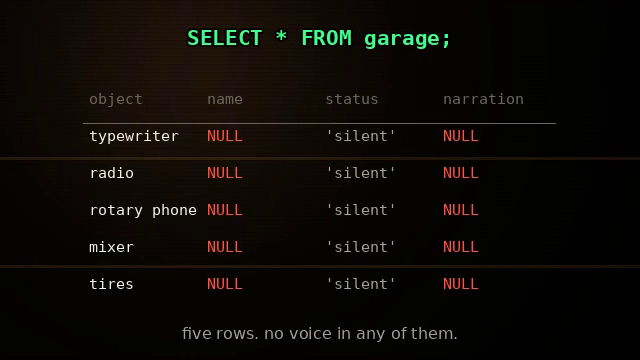
Over a dark, flickering line-art garage, a query types itself out:
SELECT * FROM garage; A table draws itself, one row per object — typewriter, radio, rotary phone, mixer, tires — every row with name NULL, status 'silent', narration NULL (the NULLs in red). Footer: "five rows. no voice in any of them."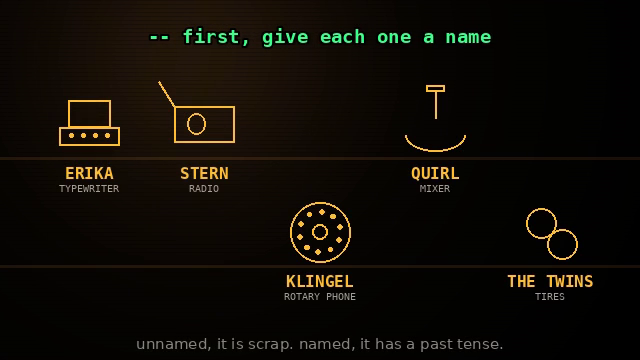
The query line becomes a comment:
-- first, give each one a name. The five objects light up one at a time on their shelves, each gaining a name over its label: ERIKA (typewriter), STERN (radio), KLINGEL (rotary phone), QUIRL (mixer), THE TWINS (tires). Footer: "unnamed, it is scrap. named, it has a past tense." (These names are the lab's invention — the paper does not list the artifacts' names; that disclosure is also in the explainer card and the film's own credits.)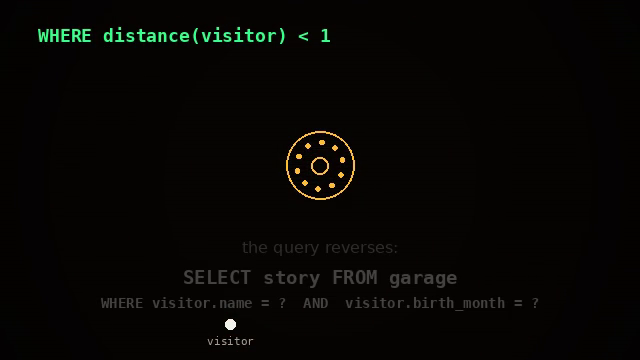
A dot labelled
visitor walks in from the left while the query WHERE distance(visitor) < 1 types out overhead. The rotary phone at the centre rings in three bursts (the bell in the score matches them), under the line "the object calls you". Then the screen turns it around: "the query reverses: SELECT story FROM garage WHERE visitor.name = ? AND visitor.birth_month = ?"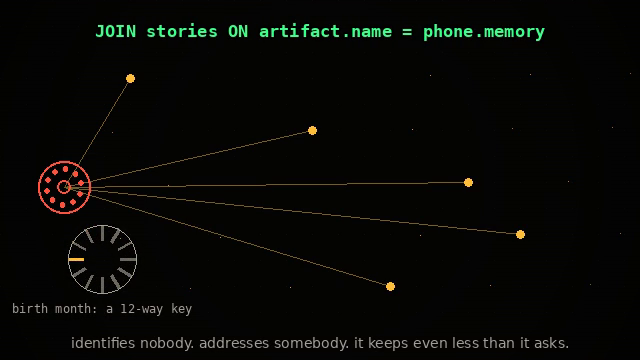
JOIN stories ON artifact.name = phone.memory types out over a dark map of city dots. Threads run from the phone to five lit points in the city. At lower left a rotary dial of 12 segments turns with audible clicks, captioned "birth month: a 12-way key". Footer: "identifies nobody. addresses somebody. it keeps even less than it asks."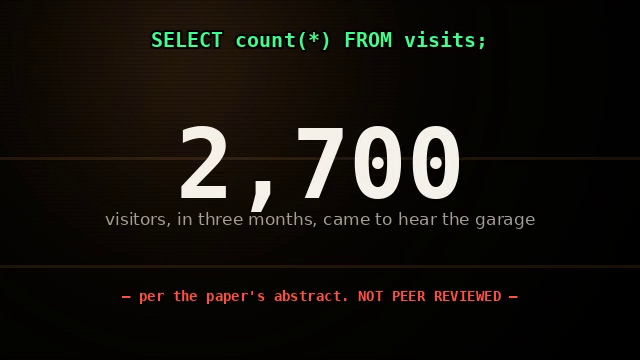
SELECT count(*) FROM visits; A counter climbs to 2,700 — "visitors, in three months, came to hear the garage" — and a red stamp fades in under it: — per the paper's abstract. NOT PEER REVIEWED —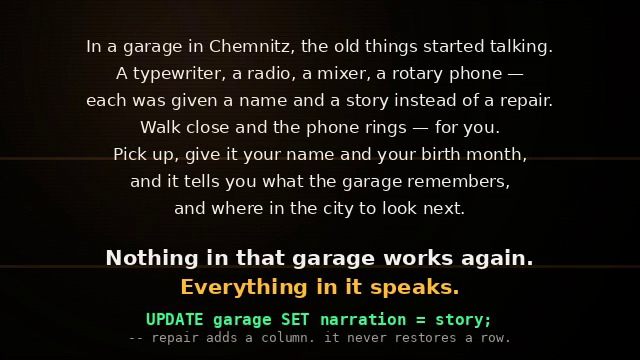
Seven lines fade in one by one:
In a garage in Chemnitz, the old things started talking.
A typewriter, a radio, a mixer, a rotary phone —
each was given a name and a story instead of a repair.
Walk close and the phone rings — for you.
Pick up, give it your name and your birth month,
and it tells you what the garage remembers,
and where in the city to look next.
Then, larger: "Nothing in that garage works again. Everything in it speaks." And the last query:
UPDATE garage SET narration = story; with its comment: -- repair adds a column. it never restores a row."THE ORACLE OF CHEMNITZ — after Köpferl & Kurze, arXiv 2608.17407v3 — NOT PEER REVIEWED. Facts from the abstract; the artifacts' names are the lab's invention. Every world: one DuckDB query per frame. Score: a bell on inharmonic partials, dial clicks, a slow bed."
The Score (instrumental, no speech): A quiet slow chord bed (Dm–F–C–A triangle pads with a sparse sine arpeggio) throughout. At 0:26–0:40, three bursts of inharmonic bell strikes (ratios
1.0, 2.02, 2.74, 3.76, 5.40 — a bell owes nobody integers) are the phone ringing, ending in one soft strike as the receiver lifts. At 0:40–0:46, short clicks are the rotary dial turning and spinning back. One final C6 bell chime sounds under the credits. Integrated loudness −17.5 LUFS, decoded true peak −1.3 dBFS.